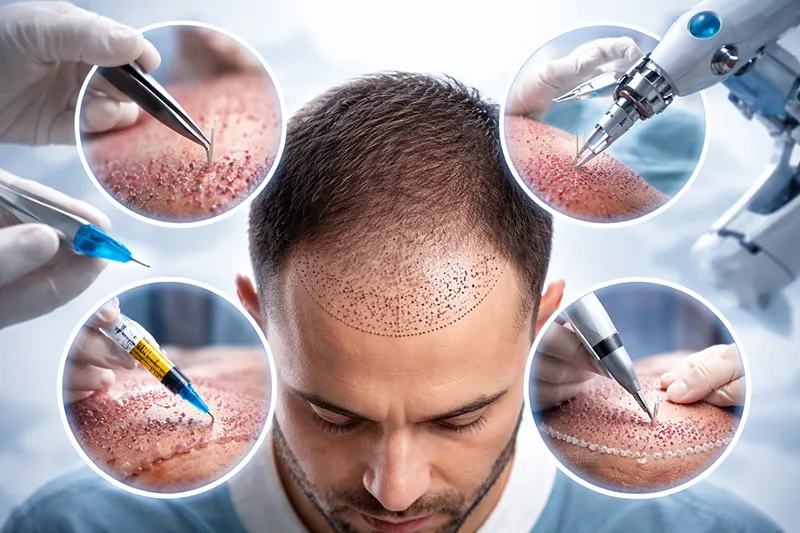
Are you losing your hair and wondering which hair transplant method is right for you? Many people ask the same questions: Is it painful? Will it look natural? How long does it last? Which method is the best? Choosing between different types of hair transplant can feel confusing, especially when you see names like FUE, FUT, or DHI. Each method has its own benefits, recovery time, cost, and suitability depending on your hair loss level, hair type, and personal expectations. Some people worry about scars. Others are afraid of unnatural results. Many are simply unsure which clinic or country to trust.
The good news is that modern hair transplant techniques are much safer and more advanced than in the past. When performed by experienced specialists, results can look completely natural and permanent. The key challenge is understanding the differences and selecting the right method for your condition. You should consider factors like donor hair quality, hair density, budget, and recovery time. A proper consultation with a professional team can help you make the best decision with confidence and peace of mind.
If you are thinking about hair transplant in Iran, Medexa Trip is a trusted medical tourism company that helps international patients receive high quality treatment with very affordable costs. With experienced doctors, modern clinics, and natural looking results, Medexa Trip supports you from consultation to recovery, making your hair restoration journey safe, smooth, and successful.
Guide to the Types of Hair Transplant Procedures
Hair loss can affect confidence, appearance, and even social life. Many people start searching for solutions but quickly feel confused by different medical terms and techniques. What is the difference between FUE and FUT? Is DHI better? Which method gives the most natural result? The truth is that there is no single “best” method for everyone. The right procedure depends on your level of hair loss, the quality of your donor hair, your budget, and your expectations. Understanding the basic differences can help you make a smart and confident decision.
Modern hair transplant procedures are designed to create natural, permanent results when performed by skilled specialists. Some methods focus on maximum graft numbers, while others focus on precision and density. Recovery time, scarring, and cost may also vary. Before choosing a method, it is important to have a professional consultation, realistic expectations, and a clear understanding of your goals. The guide below gives you a simple comparison to help you understand the main options available today.
Comparison of Hair Transplant Methods
| Procedure | How It Works | Main Advantage | Possible Limitation | Best For |
|---|---|---|---|---|
| FUT (Follicular Unit Transplantation) | A thin strip of scalp is removed and divided into grafts | High number of grafts in one session | Linear scar in donor area | Advanced hair loss |
| FUE (Follicular Unit Extraction) | Individual follicles are extracted one by one | Minimal scarring and faster recovery | May take longer time | Mild to moderate hair loss |
| DHI (Direct Hair Implantation) | Follicles are implanted using a special pen tool | High precision and natural hairline design | Usually higher cost | Patients seeking dense, detailed results |
| Sapphire FUE | FUE technique using sapphire blades for incisions | Smaller incisions and faster healing | Technique dependent on surgeon skill | Patients wanting faster recovery |
How to Choose the Right Procedure?
If you are unsure which method is suitable for you, start by asking these simple questions:
- How advanced is my hair loss?
- Do I want the shortest recovery time?
- Is avoiding visible scarring important for me?
- What is my budget?
- How important is maximum density?
A professional evaluation of your scalp, donor area, and medical history is essential. The best decision is always based on medical advice, not marketing promises. When you understand your options clearly, you can move forward with confidence and realistic expectations.
Consultation for the Best Hair Transplant Method in Iran for You
Choosing the right hair transplant method is not just about selecting FUE or DHI — it is about finding the technique that truly matches your hair loss pattern, donor area quality, expectations, and budget. Medexa Trip connects you directly with some of the best hair transplant doctors and specialists in Iran for a professional evaluation. After reviewing your photos and medical details, the medical team will recommend the most suitable method for you and provide a clear explanation of the expected results, number of grafts, recovery time, and full cost details. With Medexa Trip, you receive honest guidance, personalized consultation, and support throughout your medical journey in Iran.
Fill out the contact form today, and our team will reach out to you on WhatsApp for a free consultation and step by step assistance.
Different Types of Hair Transplant Techniques
Hair transplantation has become one of the most effective and permanent solutions for hair loss. Thanks to medical advances, modern techniques can create natural hairlines, high density, and long lasting results with minimal discomfort. However, each technique has different advantages, recovery times, costs, and suitability depending on the patient’s hair loss stage, donor area quality, and expectations. Understanding these differences helps you choose the safest and most effective option for your specific condition.
Main Types of Hair Transplant Techniques
- FUT (Follicular Unit Transplantation)
- FUE (Follicular Unit Extraction)
- DHI (Direct Hair Implantation)
- Sapphire FUE
- Robotic Hair Transplant
1. FUT (Follicular Unit Transplantation)
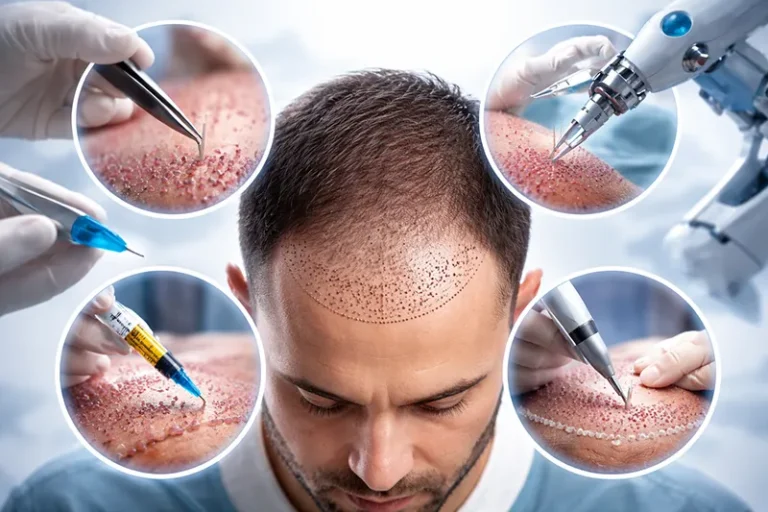
FUT, also known as the strip method, involves removing a thin strip of scalp from the donor area (usually the back of the head). The strip is then divided into individual follicular units and implanted into the balding areas. This technique is suitable for patients with advanced hair loss who need a large number of grafts in one session. The procedure usually takes 4 to 8 hours depending on graft count. It provides high graft survival rates and strong density. However, it leaves a linear scar in the donor area. Recovery takes about 10 to 14 days. FUT is often more cost effective compared to advanced implantation techniques.
2. FUE (Follicular Unit Extraction)
FUE is one of the most popular and widely used techniques today. In this method, individual hair follicles are extracted one by one using a micro punch tool and implanted into the recipient area. It is ideal for patients with mild to moderate hair loss or those who prefer short hairstyles because it leaves tiny dot scars that are barely visible. The procedure may take 6 to 8 hours. Recovery is relatively fast, usually within 7 to 10 days. Results are natural and permanent when performed by experienced surgeons. The cost is moderate and depends on the number of grafts.
3. DHI (Direct Hair Implantation)
DHI is an advanced version of FUE. After follicle extraction, grafts are implanted directly using a special implanter pen without creating separate incisions beforehand. This allows precise control over angle, direction, and depth, which helps create very natural hairlines and high density results. DHI is suitable for patients who want detailed hairline design or increased density in smaller areas. The procedure may take longer than standard FUE. Recovery is similar to FUE, around 7 to 10 days. It is generally more expensive due to the specialized tools and precision involved.
4. Sapphire FUE
Sapphire FUE follows the same extraction method as traditional FUE but uses sapphire blades instead of steel blades to create recipient channels. Sapphire blades allow smaller, more precise incisions, which may reduce tissue trauma and speed up healing. It is suitable for patients seeking faster recovery and dense implantation. The procedure time is similar to FUE. Healing can be slightly quicker, with less swelling in some cases. Costs are usually slightly higher than standard FUE but lower than DHI in many clinics.
5. Robotic Hair Transplant
Robotic hair transplant is a technology assisted version of FUE. A robotic system helps identify and extract healthy follicles with precision. It may improve consistency and reduce human error. This technique is suitable for patients who prefer advanced technology driven procedures. Procedure duration varies but is similar to FUE. Recovery time is also comparable. However, availability is limited, and costs are generally higher due to the use of robotic equipment.
Summary Comparison Table
| Technique | Best For | Procedure Time | Recovery Time | Scarring | Cost Level | Effectiveness |
|---|---|---|---|---|---|---|
| FUT | Advanced hair loss | 4 to 8 hours | 10 to 14 days | Linear scar | Moderate | High graft survival |
| FUE | Mild to moderate hair loss | 6 to 8 hours | 7 to 10 days | Minimal dot scars | Moderate | Very natural results |
| DHI | Detailed hairline and density | 6 to 9 hours | 7 to 10 days | Minimal | Higher | Very precise and dense |
| Sapphire FUE | Faster healing preference | 6 to 8 hours | 7 to 9 days | Minimal | Moderate to high | Dense and natural |
| Robotic | Technology based preference | 6 to 8 hours | 7 to 10 days | Minimal | High | Consistent extraction |
Choosing the right technique should always be based on medical evaluation, realistic expectations, and consultation with an experienced hair transplant specialist. Each method can deliver excellent and permanent results when performed correctly, but the best choice depends on your individual needs. With Medexa Trip, you can receive professional consultation with some of the best and most experienced hair transplant specialists in Iran, ensuring a personalized treatment plan and outstanding natural results at a very competitive cost.
Free Consultation
Get a free consultation with Iran’s top specialists and doctors — including a complete evaluation of your medical condition and direct communication with the expert team to choose the most effective treatment plan.
Robotic and Manual Types of Hair Transplant
Hair transplant procedures in 2026 can be broadly divided into robotic and manual methods, each with its own advantages. Manual techniques, like traditional FUE or FUT, rely entirely on the surgeon’s skill to extract and implant hair follicles. These methods are highly flexible and allow the doctor to make artistic decisions about hairline design and density, but results depend heavily on experience. Robotic hair transplant, on the other hand, uses advanced robotic systems to assist in follicle extraction, providing consistent precision, reducing human error, and improving efficiency for large sessions. Both approaches can deliver natural, long-lasting results, but the choice depends on your hair loss pattern, desired density, and preference for technology-assisted precision versus hands-on customization.
For patients seeking world-class hair restoration, Medexa Trip in Iran connects you with experienced specialists who perform both robotic and manual procedures using the latest techniques, ensuring natural results at highly competitive costs.
Do Hair Transplant Methods Deliver Natural Results?
Many people considering hair transplant wonder: Will it look real? Will anyone notice it’s transplanted? In 2026, modern hair transplant techniques are designed to create results that are virtually indistinguishable from natural hair. Factors such as the skill of the surgeon, the angle and direction of implanted follicles, and the quality of donor hair all play a major role in achieving a natural look. While all modern methods can produce good results, some techniques are specifically better at mimicking the natural hairline and density. Choosing the right method and an experienced specialist is the key to ensuring your hair restoration looks seamless and authentic.
| Method | Naturalness Level | Key Reason | Best For |
|---|---|---|---|
| FUE | High | Precise placement of individual follicles | Most patients seeking natural results with minimal scarring |
| DHI | Very High | Implantation with a pen allows exact angle, direction, and density | Detailed hairlines, high-density areas |
| Sapphire FUE | High | Smaller, precise channels reduce trauma and improve hair alignment | Patients wanting faster healing and natural look |
| FUT | Moderate to High | Large grafts in one session can create dense results, but linear scar may be visible | Advanced hair loss requiring many grafts |
| Robotic FUE | High | Consistent extraction and placement improve symmetry | Patients preferring technology-assisted precision |
For the most natural and long-lasting results, professional guidance is essential. With Medexa Trip in Iran, you can access the latest hair transplant techniques performed by the world’s most experienced specialists, using top-quality materials, all at a fraction of the cost compared to Europe or the USA.
Comparing Modern Types of Hair Transplant Methods
Hair restoration today is no longer a one option solution. Modern hair transplant methods are designed with different goals in mind: higher density, faster healing, minimal scarring, or maximum graft numbers in one session. For many patients, the real challenge is not whether hair transplant works, but which technique matches their hair type, hair loss stage, lifestyle, and budget. A clear comparison helps you move beyond marketing terms and understand what truly matters: precision, recovery time, long term results, and overall value.
| Method | Main Focus | Invasiveness Level | Healing Speed | Density Potential | Suitable For | Cost Range |
|---|---|---|---|---|---|---|
| FUT | Maximum grafts in one session | Moderate | Moderate | High | Advanced hair loss | $$ |
| FUE | Minimal scarring | Low | Fast | High | Mild to moderate hair loss | $$ |
| DHI | Precision implantation | Low | Fast | Very High | Hairline design and dense areas | $$$ |
| Sapphire FUE | Smaller incisions | Low | Slightly faster than FUE | High | Patients wanting faster recovery | $$–$$$ |
| Robotic FUE | Technology assisted extraction | Low | Fast | High | Patients preferring tech driven procedures | $$$$ |
Understanding these differences allows you to choose a method based on medical suitability rather than trends. The best technique is the one that balances safety, natural appearance, recovery comfort, and long term satisfaction according to your personal needs.
Best Hair Transplant Methods for Men and Women
Hair loss affects both men and women, but the patterns, causes, and treatment approaches often differ. Men usually experience receding hairlines or bald spots, while women often face diffuse thinning across the scalp. Because of these differences, the best hair transplant methods may vary. Some techniques are better for creating a strong, natural hairline in men, while others are more suitable for improving overall density in women. Understanding these distinctions helps ensure the most effective and natural-looking results for each patient.
Recommended Hair Transplant Methods by Gender
| Gender | Best Methods | Reason / Explanation |
|---|---|---|
| Men | FUE, DHI, Sapphire FUE | These methods allow precise hairline design and high-density placement, ideal for receding hairlines and bald spots. |
| Women | FUE, DHI, PRP-Assisted FUE | Women benefit from methods that improve overall density and coverage rather than hairline reconstruction; less invasive options reduce scarring and downtime. |
| Both | Robotic FUE | Technology-assisted precision works well for men and women, ensuring uniform extraction and natural results. |
The difference in approach comes down to hair loss pattern, scalp condition, and cosmetic goals. Men often need strong frontal density and hairline shaping, while women prioritize diffuse coverage and natural thickness.
For world-class results in both men and women, Medexa Trip in Iran connects patients with top specialists who use the latest techniques, ensuring natural, safe, and cost-effective hair restoration.
FUE vs FUT: A Detailed Comparison
Choosing between FUE (Follicular Unit Extraction) and FUT (Follicular Unit Transplantation) is one of the most common decisions for anyone considering hair transplant. Both techniques are effective and can give natural, permanent results, but they differ in procedure, recovery, cost, and suitability. Understanding these differences helps you pick the method that best fits your hair loss pattern, lifestyle, and expectations.
Here’s a detailed comparison of FUE and FUT:
- Candidates:
- FUE: Best for patients with mild to moderate hair loss, those who prefer short hairstyles, or people concerned about visible scars.
- FUT: Ideal for patients with advanced hair loss who need a large number of grafts in a single session.
- Procedure:
- FUE: Individual follicles are extracted using a micro punch tool, then implanted in balding areas. No large incision is made.
- FUT: A strip of scalp is removed from the donor area, divided into grafts, and then implanted.
- Pain and Comfort:
- FUE: Less post-operative discomfort, no stitches required, usually mild pain.
- FUT: Slightly more discomfort due to stitches in donor area; stretching of scalp can cause soreness.
- Scarring:
- FUE: Tiny dot scars that are almost invisible, suitable for short hairstyles.
- FUT: Linear scar in the donor area, may be visible if hair is cut very short.
- Recovery Time:
- FUE: Faster recovery, usually 7–10 days.
- FUT: Slower recovery, typically 10–14 days, due to stitches and donor area healing.
- Time of Procedure:
- FUE: May take longer if a large number of grafts are needed (6–8 hours or more).
- FUT: Can transplant more grafts in a single session (4–8 hours).
- Cost:
- FUE: Moderate, depends on number of grafts; slightly more expensive than FUT for the same number of grafts.
- FUT: Usually more cost-effective for large sessions, as fewer resources are needed.
- Results and Effectiveness:
- Both methods produce natural, permanent results when performed by skilled surgeons. FUT may be preferred if maximum graft count is the goal, while FUE is favored for minimal scarring and faster recovery.
- Best Choice Considerations:
- Choose FUE if you want less visible scarring, faster healing, or prefer short hairstyles.
- Choose FUT if you need many grafts in a single session and don’t mind a linear scar.
The Best Hair Transplant Method in 2026
In 2026, the most effective and widely recommended hair transplant method is FUE (Follicular Unit Extraction), especially when performed with advanced tools like sapphire blades or DHI implantation pens. Scientifically, FUE offers precise extraction of individual hair follicles, minimizing trauma to the scalp and ensuring high graft survival rates. Unlike older techniques, it leaves almost no visible scarring, allows faster recovery, and provides natural-looking results by controlling the angle, direction, and density of each follicle. While FUT can still be effective for patients needing very large graft numbers, FUE’s combination of safety, precision, and minimal invasiveness makes it the preferred choice for most patients in 2026, regardless of hair type or age, offering durable, long-term results with fewer complications.
Surgical and Non-Surgical Types of Hair Transplant
Are you struggling with hair loss and wondering whether a surgical procedure is the only solution? Or could non-surgical options work for you? In 2026, hair restoration offers both surgical and non-surgical methods, each with unique advantages depending on your hair loss stage, goals, and lifestyle. Surgical techniques like FUE and FUT provide permanent, high-density results, while non-surgical options such as PRP therapy or scalp micropigmentation can improve hair appearance, stimulate growth, or cover thinning areas without invasive surgery. The real question is: which approach fits your needs, budget, and comfort level? Understanding the differences can help you make a confident choice for your hair restoration journey.
| Type | Examples | How It Works | Recovery Time | Effectiveness | Best For | Cost Range |
|---|---|---|---|---|---|---|
| Surgical | FUE, FUT, DHI, Sapphire FUE | Follicles are transplanted from donor to recipient areas | 7–14 days | Permanent, natural results | Patients wanting long-term hair restoration and high density | $$–$$$$ |
| Non-Surgical | PRP Therapy, Scalp Micropigmentation, Hair Growth Medications | Stimulates growth, improves hair density, or conceals thinning areas without surgery | Little to no downtime | Temporary or supportive results | Patients with mild hair loss, thinning, or those avoiding surgery | $–$$$ |
Do you want permanent, full restoration, or just to improve hair appearance and growth? Surgical methods are ideal for those ready for long-term results and higher density, while non-surgical techniques offer lower risk, less downtime, and gradual improvement. Many patients combine both approaches for optimal results, using non-surgical treatments to support growth after surgery.
In 2026, if you are looking for the most advanced hair transplant techniques in the world at a fraction of the cost compared to Europe or the United States, Iran has become a leading destination. With Medexa Trip, you can access the latest methods like FUE, DHI, and Sapphire FUE using the best quality materials and instruments. You will be treated by some of the most experienced hair transplant specialists in the world, ensuring natural, long-lasting results. Choosing Iran for your hair restoration means combining top-tier expertise, cutting-edge technology, and affordable costs for an excellent, safe, and comfortable hair transplant experience.
Recovery Time for Different Hair Transplant Methods
Recovery time is one of the most important considerations when choosing a hair transplant method. In 2026, modern techniques focus not only on natural and permanent results but also on minimizing downtime and discomfort. Each method has a different healing process depending on how invasive it is, the number of grafts, and individual patient factors. While some methods allow patients to resume normal activities within a week, others require slightly longer recovery periods. Understanding these timelines helps you plan your procedure and manage expectations.
| Method | Typical Recovery Time | Key Notes | Best For |
|---|---|---|---|
| FUE | 7–10 days | Minimal scarring, faster return to daily activities | Mild to moderate hair loss, short hairstyles |
| DHI | 7–10 days | Direct implantation reduces trauma, fast healing | Detailed hairline design, high-density areas |
| Sapphire FUE | 7–9 days | Smaller, precise channels promote quicker healing | Patients seeking faster recovery and natural look |
| FUT | 10–14 days | Linear scar requires care, slightly longer downtime | Advanced hair loss needing large grafts |
| Robotic FUE | 7–10 days | Consistent extraction, gentle handling | Patients preferring technology-assisted precision |
For anyone considering hair transplant, Iran has become a top destination in 2026 for advanced, safe, and affordable procedures. With Medexa Trip, you can access world-class clinics and experienced specialists who ensure high-quality results, natural-looking hairlines, and smooth recovery, all at a fraction of the cost compared to Europe or the United States.
Cost Comparison of Different Types of Hair Transplant
When considering a hair transplant, cost is always an important factor — but it shouldn’t be the only one. Different methods require different levels of expertise, time in the clinic, technology, and precision. Some techniques may take longer, need more grafts, or involve specialized tools, all of which influence the overall investment. Rather than giving fixed prices, this comparison focuses on relative cost expectations so you can understand which procedures are typically more affordable and which ones involve more resources.
It’s also important to remember that cost differs between countries, clinics, and individual needs. Many people seek hair transplant in Iran because advanced methods are available at much more competitive pricing than in Europe or the United States, with no compromise on quality or results.
| Hair Transplant Method | Relative Cost Level | Why? |
|---|---|---|
| FUE | Moderate | Standard technique, widely available, minimal scarring |
| FUT | Lower to Moderate | Simpler extraction but larger session capability |
| DHI | Higher | Specialized implantation tool and precision work |
| Sapphire FUE | Moderate to High | Advanced incisions with sapphire blades |
| Robotic FUE | High | Technology-assisted precision extraction |
👉 To see accurate costs and a personalized plan, you can visit our page about Hair Transplant in Iran or contact Medexa Trip. Our team will connect you with top specialists in Iran, assess your needs, and give you a detailed cost estimate tailored just for you.
Pros and Cons of Various Types of Hair Transplant
Hair transplant techniques in 2026 offer natural, long-lasting results, but each method has its strengths and limitations. Understanding the advantages and drawbacks of each type can help you decide which approach matches your hair loss pattern, lifestyle, and expectations. The best choice often depends on balancing results, recovery time, scarring, cost, and precision.
- FUE (Follicular Unit Extraction)
- Pros: Minimal scarring, faster recovery, natural-looking results, suitable for short hairstyles.
- Cons: Longer procedure time for large sessions, slightly higher cost per graft.
- DHI (Direct Hair Implantation)
- Pros: Maximum precision, dense results, natural hairline design, reduced trauma to scalp.
- Cons: Higher cost, longer procedure time, requires specialized equipment and skilled surgeons.
- FUT (Follicular Unit Transplantation)
- Pros: Can transplant large number of grafts in one session, cost-effective for advanced hair loss.
- Cons: Linear scar, longer recovery, not ideal for very short hairstyles.
- Sapphire FUE
- Pros: Smaller, precise incisions, faster healing, less swelling, natural appearance.
- Cons: Slightly higher cost than standard FUE, depends on surgeon’s skill.
- Robotic FUE
- Pros: High precision, consistent extraction, gentle handling of follicles, reduced human error.
- Cons: Limited availability, higher cost, procedure time similar to manual FUE.
For anyone considering hair transplant, consulting experienced specialists ensures you select the method that best suits your goals and provides the most natural, long-lasting results. In Iran, Medexa Trip connects you with top Iranian specialists using the latest techniques at a fraction of the cost compared to Europe or the USA, making advanced hair restoration accessible and reliable.
The Fastest Hair Transplant Method
When it comes to speed without compromising quality, FUE (Follicular Unit Extraction) combined with modern implantation techniques like DHI (Direct Hair Implantation) is considered the fastest method in 2026. Unlike traditional FUT, which requires removing a strip of scalp and stitching the donor area, FUE extracts individual follicles directly, reducing surgical trauma and enabling quicker implantation. With DHI, follicles are implanted immediately using a specialized pen, eliminating the need for pre-made incisions. This streamlined process significantly shortens procedure time, allowing large sessions to be completed efficiently while maintaining precision and natural-looking results.
Patients benefit from faster healing and less downtime compared to older methods. Typically, most FUE-DHI sessions take 6–8 hours for 2,000–3,000 grafts, and recovery begins within a week, making it ideal for those who want effective hair restoration with minimal disruption to daily life. Moreover, the combination of these techniques maximizes graft survival, hair density, and long-term results, proving that speed and quality can go hand in hand when advanced technology is used.
Painless Hair Transplant Methods
Hair transplant doesn’t have to be painful or stressful. With modern techniques, the procedure can be much more comfortable than people often expect. Thanks to local anesthesia, advanced extraction tools, and precise implantation methods, most patients feel little to no pain during the surgery and experience a smooth recovery afterward. While no medical procedure is completely painless, today’s approaches are designed to make the process as gentle and stress-free as possible.
Painless Hair Transplant Techniques:
- FUE with Local Anesthesia – Individual hair follicles are carefully removed under local anesthesia, so you won’t feel much during the procedure.
- DHI (Direct Hair Implantation) – Using a special pen, follicles are placed directly into your scalp, reducing trauma and avoiding extra incisions.
- Sapphire FUE – Sapphire blades create smaller, precise channels, which means less swelling, irritation, and faster healing.
- Robotic FUE – Robots help extract follicles gently and accurately, making the experience smoother and more comfortable.
- PRP-Assisted Transplant – Platelet-rich plasma can be used alongside your grafts to speed up healing and reduce soreness.
With these techniques, hair transplant can feel much easier and more manageable than many people expect, letting you focus on the results rather than the discomfort.
Choosing the Right Type of Hair Transplant for You
Are you unsure which hair transplant method suits you best? Many people start their hair restoration journey confused about FUE, FUT, DHI, or other techniques. The truth is, choosing the right procedure isn’t just about the name of the method—it’s about your hair type, hair loss stage, donor area quality, lifestyle, and personal goals. This is why professional consultation is crucial. A specialist can evaluate your scalp, discuss realistic results, and recommend the method that will give the best natural outcome for you.
Some parts of the consultation can be done online, like sharing photos, medical history, and asking questions about recovery or cost. This usually gives a good initial assessment and helps you prepare. However, a final, accurate evaluation should be done in person, where the doctor can examine your donor area, scalp elasticity, and hair density to determine the exact technique, number of grafts, and estimated cost. The good news is that in Iran, thanks to modern clinics and experienced specialists, you can access these consultations at very affordable rates compared to Europe or the United States. With the right guidance, you can confidently choose the procedure that fits you best and get results that look natural, permanent, and tailored to your needs.